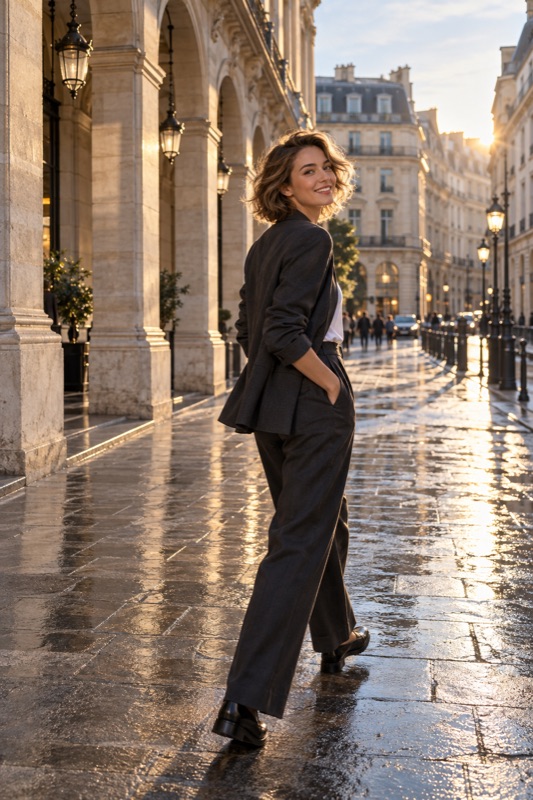
Use the rule of thirds as a starting option: imagine two equally spaced vertical and horizontal lines, then place an important subject near a crossing. Compare that with a centered frame. Keep whichever arrangement best shows the person, place, or relationship you want the photograph to communicate.
Get it on Google PlayDecide what the picture is about
Before moving your subject onto a grid line, finish this sentence: I want someone to notice this first. In an outfit picture it may be the complete look; in a travel portrait it may be the person together with the location. A technically tidy grid placement is not useful if it makes the important detail disappear.
Give the main subject enough space to read at a normal viewing size. Then ask what the remaining area contributes. A café doorway may explain the outing, while a bright advertising board may simply compete with the face. Composition includes deciding what to leave out.
Try thirds, then deliberately compare the center
Nikon's composition guide describes a three-by-three grid and suggests placing a subject near an intersection, rather than requiring exact alignment. Enable your native camera's grid if it has one, or imagine the lines. For a portrait, move the whole camera gently until the face sits near a crossing; do not tilt the phone merely to reach a mark.
Now take a centered version from the same distance. A symmetrical doorway, direct gaze, or balanced reflection may work well centrally. These are alternatives to compare, not a ranking of correct and incorrect photos. Choose the version that makes the intended subject feel most clear.
Use the horizon to choose your emphasis
A low horizon leaves more frame for the sky; a high one leaves more for the foreground. Nikon also identifies reflections as a reason to consider a centered horizon. Decide which part of your particular scene carries the interest instead of moving the horizon automatically.
Check whether the phone is level before asking someone to pose. Correcting a sloping horizon later usually requires cropping. Leave a little spare room if important shoes, architecture, or the edge of a hat are close to the frame boundary. The grid is also a useful visual reference for this check.
Scan the edges and the space around the face
An off-center subject does not rescue a cluttered background. Look around the head for poles or branches that seem to connect to it, then look along all four edges for partial strangers, clipped fingers, or bright objects. Often a small sideways step changes these relationships more effectively than zooming.
Check the direction of the person's attention. If she looks toward a view, compare a frame with room in that direction against one cropped tightly in front of her. Keep the version that feels right for the story; a deliberately tight crop can create a different mood.
| Your intention | Composition to compare | Detail to protect |
|---|---|---|
| Show an outfit | Centered full-length and slightly off-center | Shoes, sleeves, and the complete silhouette |
| Remember a location | Person to one side with meaningful scenery | The landmark should remain recognizable |
| Show a reflection | Centered and shifted horizons | Enough room for the reflected subject |
| Emphasize an expression | Closer centered and thirds portraits | Eyes, face, and an uncluttered background |
Practise with three frames, not thirty rules
Illustrative exercise: place a mug on a table with a window behind or beside it. Photograph it centrally, near the left third, and near the right third. Keep your distance and light as consistent as practical. These are practice frames, not a product performance test.
Review the three images without the grid. Where does your eye go first? Does the space look intentional? Is anything competing with the mug? Repeat the exercise with a willing friend and a meaningful background. Your goal is to recognize a useful choice quickly, not to memorize a compulsory placement.
- Name the subject and the detail the photo must preserve.
- Compare one centered and one off-center composition.
- Check the horizon and all four frame edges.
- Remove a distraction by moving your camera position.
- Choose by the saved image, not by perfect grid alignment.
Before your next photo walk
Does the subject have to sit exactly on a thirds intersection?
No. Treat the grid as a visual aid. A nearby placement may work better when it preserves the expression, background, or full outfit.
Is a centered portrait a composition mistake?
No. Centering can support symmetry or a direct connection with the person. Compare both arrangements and judge the photograph rather than the rule.
ShotCoach AI
Need a direction while holding the phone? ShotCoach AI offers paid framing guidance and supported camera adjustments. Review the suggestion and press the shutter when the composition feels right.
Get it on Google PlayAvailable for Android · AI guidance is paid